NEW ATTRACTION FOR
SCT. BENDT'S CHURCH
RING PLACE
MIDDLE AGES-
FESTIVAL
August 14 - 16, 2026
WHY IS SCT. BENDT'S CHURCH SPECIAL?
In the Middle Ages, Ringsted was one of Denmark's most important centers of power. In the middle of Zealand, the kingdom's most powerful men gathered at the Thing, where the highest judicial body belonged. At the Thing, kings were both elected and honored, and criminal cases were decided. The Thing made Ringsted the legal center of Zealand.
Over time, the Thing evolved into the Zealand Landsting, which functioned as a court, first outside and later inside St. Bendts Church. In 1805, the county council was moved to Copenhagen, where it became what we know today as the Eastern High Court.
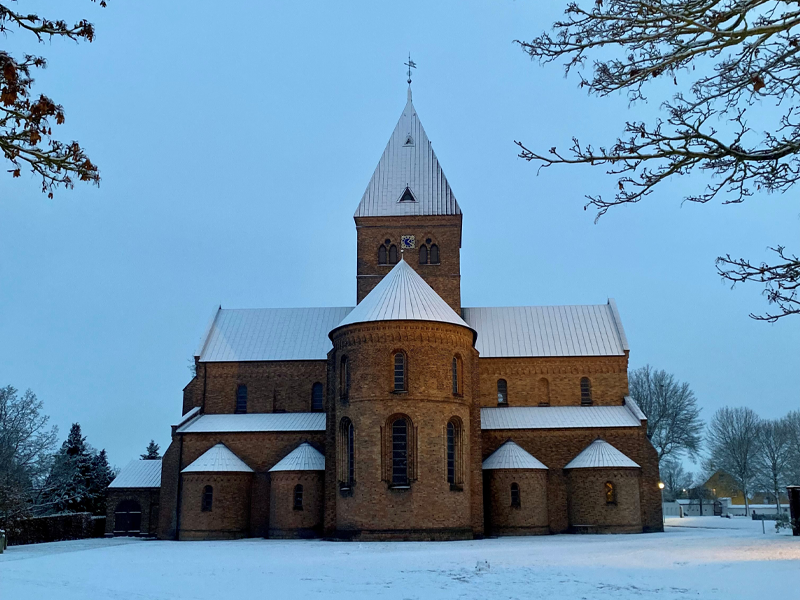
Before Sct. Bendts Kirke was built, there was a stone church on the same location, which was dedicated to the Virgin Mary. The church of St. Mary was one of the first four churches on Zealand, which was made of stone. Previously, churches had been built of wood. Ringsted therefore had not only legal significance but also religious.
In the 1160s, Valdemar the Great decided that a new and more impressive church should be built on top of the old Mariakirke. The construction of Sct. Bendts Kirke began at a time when royal power had just been reunified after many years of civil war.
In 1157, Valdemar had become sole king of Denmark after a long civil war, in which he finally triumphed over his rivals Canute and Sweyn. The new king had to show everyone that his family was strong and worthy of the throne. Valdemar needed a very special reason why his family could not be challenged. This required not only victories on the battlefield, but also a strong story about the family's right to the throne. In 1169, he succeeded in having his father – Canute Lavard – canonized by the Pope in Rome. It was something very special. Before Canute Lavard, there was only one official saint in Denmark: Canute the Holy.
Now that Valdemar had linked his lineage to an official saint and thus legitimized the kingship and the country's place in the Christian world, he did not lack much. He built the unique St. Bendt's Church, which would stand for posterity as a great monument to his powerful position.
One summer day in 1170, King Valdemar the Great took a final step towards the ultimate cementing of power. He gathered people for an event that would change the history of Denmark. At the church festival in Sct. Bendts Kirke, Valdemar had his only seven-year-old son crowned as co-king, and he thus introduced hereditary kingship in Denmark. The coronation took place by Archbishop Eskil of Lund himself – one of the most powerful men of the time.
Valdemar the Great had now shown everyone that he was the right person to sit on the throne. His family ruled the country for 84 years. This time we today call the Valdemar era. During those years, Denmark was one of the most powerful nations in Europe.
CONTACT US
Questions regarding overall frameworks and decisions:
Project Manager Jonas Abkjær Andersen
jaa@vestmuseum.dk
+45 25 59 38 51
Suggestions, inputs and questions regarding practical matters:
Project employee Laura Aagaard
laa@vestmuseum.dk
+45 23 64 26 29